
The 1989 Beijing Protests and June Fourth Crackdown
Explore the 1989 Beijing student movement, the military crackdown of June 3–4, and the prosecutions and family testimony that followed.
Places index
Beifengwo junction
Qian Jin and his classmate were shot while cycling toward Muxidi and taken by bystanders to the Railway General Hospital.
Muxidi and Fuxingmen Outer Avenue
Jiang Jielian was shot on Fuxingmen Outer Avenue. Wu Xiangdong was taken to Fuxing Hospital. Wang Weiping was shot while helping the wounded and taken to Peking University Hospital.
Xidan junction and West Rongxian Hutong
Wang Jianping and Qi Zhiyong were shot at Xidan junction and West Rongxian Hutong respectively. Both accounts identify the Beijing Emergency Center.
Liubukou
Some students leaving the square passed through here on West Chang’an Avenue. Residents and students took the injured Fang Zheng to Jishuitan Hospital.
South end of Nanchang Street
Wang Nan was shot opposite the north entrance to the Great Hall of the People. Medical students treated him at the scene after evacuation was blocked.
Nanchizi
He Jie was shot while cycling toward Tiananmen Square and was taken to Beijing Hospital.
Beijing Coking Plant entrance
Wang Gang, a mechanic who had just finished his night shift, was struck by a military truck outside the plant and later taken to Chuiyangliu Hospital.
From April mourning to the June 2 hunger strike
April 15 and the following days
Hu Yaobang’s death and the student petitions
Former Communist Party general secretary Hu Yaobang died on April 15. Students from Beijing universities gathered at Tiananmen Square to mourn him and presented demands including press freedom, increased spending on education and disclosure of leaders’ finances. Indiana University’s collection guide summarizes the seven demands.
April 26
People’s Daily publishes its April 26 editorial
A People’s Daily editorial characterized the protests that followed the mourning as turmoil. The National Security Archive’s document index reproduces an excerpt that can be read alongside the students’ demands.
April 27
Students march from their campuses toward Tiananmen
The day after the April 26 editorial, students from several Beijing universities marched, drawing support from residents along the route. Wang Chaohua, who served in the students’ autonomous organization, later recalled that many who had joined the mourning used the march to reject the editorial’s characterization. The June 4th Memory and Human Rights Museum also catalogs a contemporary booklet about the march.
May 4
March on the seventieth anniversary of the May Fourth Movement
Beijing students marched again on the seventieth anniversary of the 1919 May Fourth Movement. Human Rights in China’s chronology places the march between the formation of autonomous student organizations in late April and the start of the hunger strike in mid-May.
Beginning May 13
Hunger strike and solidarity in Tiananmen Square
Students began a hunger strike in the square on May 13. Ding Zilin recalled that on May 17 her son Jiang Jielian and his classmates organized students from the High School Affiliated to Renmin University to join a solidarity march.
May 18
Li Peng meets representatives of the hunger strikers
Premier Li Peng and other officials met representatives of the hunger strikers in the Great Hall of the People. Beijing Television’s broadcast records their discussion of the strike, the students’ health, and how talks should proceed. Zhao Ziyang visited the square the following day.
May 19–20
Zhao Ziyang visits the square · Martial law
On May 19, Communist Party general secretary Zhao Ziyang visited the hunger strikers in the square. Martial law took effect in parts of Beijing on May 20. The National Security Archive indexes diplomatic records and contemporary assessments from the days that followed.
Late May
Workers’ organization and Han Dongfang
Railway worker Han Dongfang helped organize the Beijing Workers’ Autonomous Federation. In an oral history with Human Rights in China, he recalled how workers organized and considered the relationship between an independent union and its members. The June 4th Memory and Human Rights Museum also catalogs a photograph of federation members protesting arrests outside the Beijing Public Security Bureau on May 30.
May 30
The Goddess of Democracy in the square
Associated Press photographer Jeff Widener photographed demonstrators working on the Goddess of Democracy in Tiananmen Square. AP dates the photograph to May 30 and records that the statue was destroyed when troops entered the square.
June 2
Four begin a hunger strike and issue a declaration
Liu Xiaobo, Zhou Duo, Gao Xin and Hou Dejian announced a hunger strike near the Monument to the People’s Heroes and issued a declaration emphasizing nonviolence. Participants in this hunger strike later took part in talks with troops over leaving the square.
Places and chronology, June 3–4
Daytime on June 3
Residents block troops entering the city
AP photographer Mark Avery photographed residents blocking troops on their way to Tiananmen Square. A U.S. Embassy cable indexed by the National Security Archive describes an early contingent of lightly armed soldiers turning back. Later reports record military convoys and armed troops entering the city.
Evening of June 3
Muxidi · Fuxingmen Outer Avenue
Martial-law troops advanced toward central Beijing from the west. Ding Zilin’s testimony places Jiang Jielian’s shooting on the north side of Fuxingmen Outer Avenue at about 11:10 p.m. Wu Xiangdong’s family records that he was shot near Muxidi Bridge and died at Fuxing Hospital early the next morning.
Around midnight and early June 4
Cultural Palace of Nationalities · Xinhua Gate
The Tiananmen Mothers’ case records state that Du Guangxue was shot near Xinhua Gate and died on the way to Peking Union Medical College Hospital. Duan Changlong was shot while trying to mediate a standoff near the Cultural Palace of Nationalities and died at the Posts and Telecommunications Hospital.
Early hours of June 4
South end of Nanchang Street
Drawing on witnesses and responders, Zhang Xianling recorded that Wang Nan was shot opposite the north entrance to the Great Hall of the People shortly after 1 a.m. Responders tried to treat him at the scene, and evacuation to hospital was blocked. He died at about 3:30 a.m.
Early morning through midday, June 4
First aid and transport for the wounded
Wang Nan’s case records medical students providing first aid on Nanchang Street and being prevented from taking him to hospital. Du Guangxue’s family record describes wounded people near Xinhua Gate being taken toward Peking Union Medical College Hospital by bus. An AP photograph records a separate instance of residents using a rickshaw to transport wounded people on June 4.
Morning of June 4
Monument to the People’s Heroes and the southeast corner
Zhou Duo recalled approaching troops with Hou Dejian to discuss leaving the square. A June 22 U.S. Embassy cable compiled from witness accounts places the departure of students remaining near the monument in the early morning via the southeast corner. Groups then proceeded in different directions.
Morning of June 4, after leaving the square
Liubukou, West Chang’an Avenue
Fang Zheng testified that he left the square with students and was run over at Liubukou by a tank traveling west. The Tiananmen Mothers’ records of Wang Peiwen and Dong Xiaojun also document tank deaths at Liubukou. A separate embassy cable records a witness interview about vehicle movements and the route taken by people leaving the square.
The classmate’s recollection under Wang Peiwen’s entry estimates 4–5 a.m. The adjacent editorial note gives after 6 a.m. Dong Xiaojun’s entry gives only the early morning.
After the crackdown: photographs, prosecutions and families’ investigations
June 5
A man blocks tanks on Chang’an Avenue
A man stood in front of a moving column of tanks. Photojournalist Jeff Widener photographed the scene that day. The Museum of Fine Arts, Houston catalogs the photograph with its date and photographer.
June 7–11
Streets and campuses in Haidian
In the days after the crackdown, Daiwenchen photographed mourning displays at Peking University’s south gate, street notices in Zhongguancun, and burned vehicles in Zhongguancun and outside Renmin University.
June 13
Beijing police publish a student wanted list
Beijing police issued a wanted list naming 21 students. The archive overview records the list and links to individual files for several people named on it.
June 30
Chen Xitong reports to the NPC Standing Committee
Beijing mayor Chen Xitong reported more than 200 civilian deaths, including 36 university students, and dozens of deaths among soldiers and police. Beijing Review later published the full report in English. These figures are the official counts given in that report.
1989–1993
Detention, trials and sentences
Wang Dan was sentenced to four years in January 1991 and was paroled in 1993. Chen Ziming and Wang Juntao were arrested in October 1989 and each sentenced to thirteen years in 1991. The case records cite sources for the sentences and subsequent developments.
From 1989
Families’ investigations and lists of victims
Ding Zilin, Zhang Xianling and other relatives sought witnesses and bereaved families, recording names, ages, occupations, places and circumstances of death. Ding recalled making a list of 48 people public in 1993. In 1999 she wrote that she had documented 155. The Tiananmen Mothers’ 2009 statement gives the counts from successive published lists. Each figure refers to the cases documented at that stage.
1999
Families and survivors petition for a criminal investigation
Human Rights in China reported on June 1, 1999, that 105 bereaved relatives and victims had submitted a petition to the Supreme People’s Procuratorate calling for a criminal investigation and prosecutions. Published testimony from the same year records individual cases and locations.
2014
Detentions after a commemoration seminar in Beijing
Several participants were detained after a private seminar marking June Fourth in Beijing in 2014. The event record covers the gathering, detentions and subsequent developments.
2019–2021
Victoria Park commemorations and subsequent cases
Victoria Park hosted a thirtieth-anniversary candlelight vigil on June 4, 2019, documented in the gallery below. The 2021 vigil was banned. The archive separately records Chow Hang-tung’s case and the dissolution of the Hong Kong Alliance.
Casualty records
The overall toll remains uncertain. Official figures, diplomatic estimates and named case records cover different populations and areas.
- Official report
Chen Xitong’s June 30 report to the NPC Standing Committee gave a figure of more than 200 civilian deaths, including 36 university students, and listed military and police casualties separately.
June 30, 1989; Beijing Review, no. 29, documents supplement, p. XIX.
- Contemporary diplomatic cable
The June 22 U.S. Embassy cable assembled eyewitness accounts and estimates from different sources covering several stretches of Chang’an Avenue and the area around the square. Its estimates differ from the official report in scope and population counted.
June 22, 1989; PDF page 2, paragraph 12 (casualties).
- Family investigations and lists of named victims
The Tiananmen Mothers’ 2009 statement gives the number of named victims on successive published lists: 96 in 1994, 155 in 1999, 185 in 2004 and 195 in 2009. Each list reflects the cases families had documented at the time.
2009 twentieth-anniversary statement; paragraph listing successive published totals.
From streets to hospitals
Tiananmen Mothers records trace where three victims were shot, where they were taken, and what their families learned.
- Qian Jin
Near Beifengwo junction → Railway General Hospital
Shot on the evening of June 3 and taken to hospital by bystanders. He died on June 5.
- Wang Jianping
Xidan junction → Beijing Emergency Center
Died early on June 4. His family identified him on June 7 from a photograph posted at the center.
- He Jie
Nanchizi → Beijing Hospital
Shot on the night of June 3. He died at about 3:40 a.m. on June 4.
People and testimony
People killed
Families and survivors
Student movement, withdrawal and prosecutions
Historical photographs
Crackdown photographs, June 3–5
View the photographs in the original galleries below. Some images show injured people or bodies.
Early June 3, 1989 · Beijing
Residents block advancing troops
Mark Avery photographed residents blocking troops on their way toward Tiananmen Square. One man is shown trying to pull a soldier away from his unit.
Crackdown section; Mark Avery, AP
AP Photos galleryEarly June 4, 1989 · Tiananmen Square
A burning armored vehicle and a barricade
Jeff Widener photographed a student placing a barricade in front of a burning armored personnel carrier.
Crackdown section; Jeff Widener, AP
AP Photos galleryMorning of June 4, 1989 · Near Muxidi
Burning armored vehicles on West Chang’an Avenue
This series shows armored vehicles burning near Muxidi. The original publication withheld the photographer’s name at their request.
Caption for the burning vehicles on West Chang’an Avenue near Muxidi; photographer unnamed
The Guardian’s original galleryJune 4, 1989 · Beijing
Bystanders help take wounded people to hospital
Liu Heung Shing photographed a rickshaw driver and bystanders taking wounded people to hospital. AP flags the photograph as graphic.
Crackdown section; Liu Heung Shing, AP; graphic injuries
AP Photos galleryJune 5, 1989 · Beijing
Tank patrols and street barricades
The Guardian gallery records street patrols the day after the crackdown and shows a tank passing through a roadblock made of buses.
Gallery entry dated June 5; photographer unnamed
The Guardian’s original gallery
Photographs held in this archive
From the 1989 demonstrations and their aftermath in Beijing to the 2019 candlelight vigil in Hong Kong.
View all nine photographs from Haidian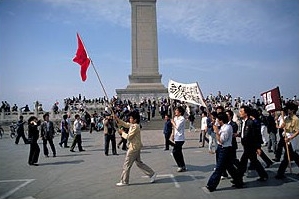
A scene from the student protests in Tiananmen Square, Beijing, on June 2, 1989.
Jiří Tondl · CC BY-SA 4.0. The timeline displays a grayscale crop under the same license.

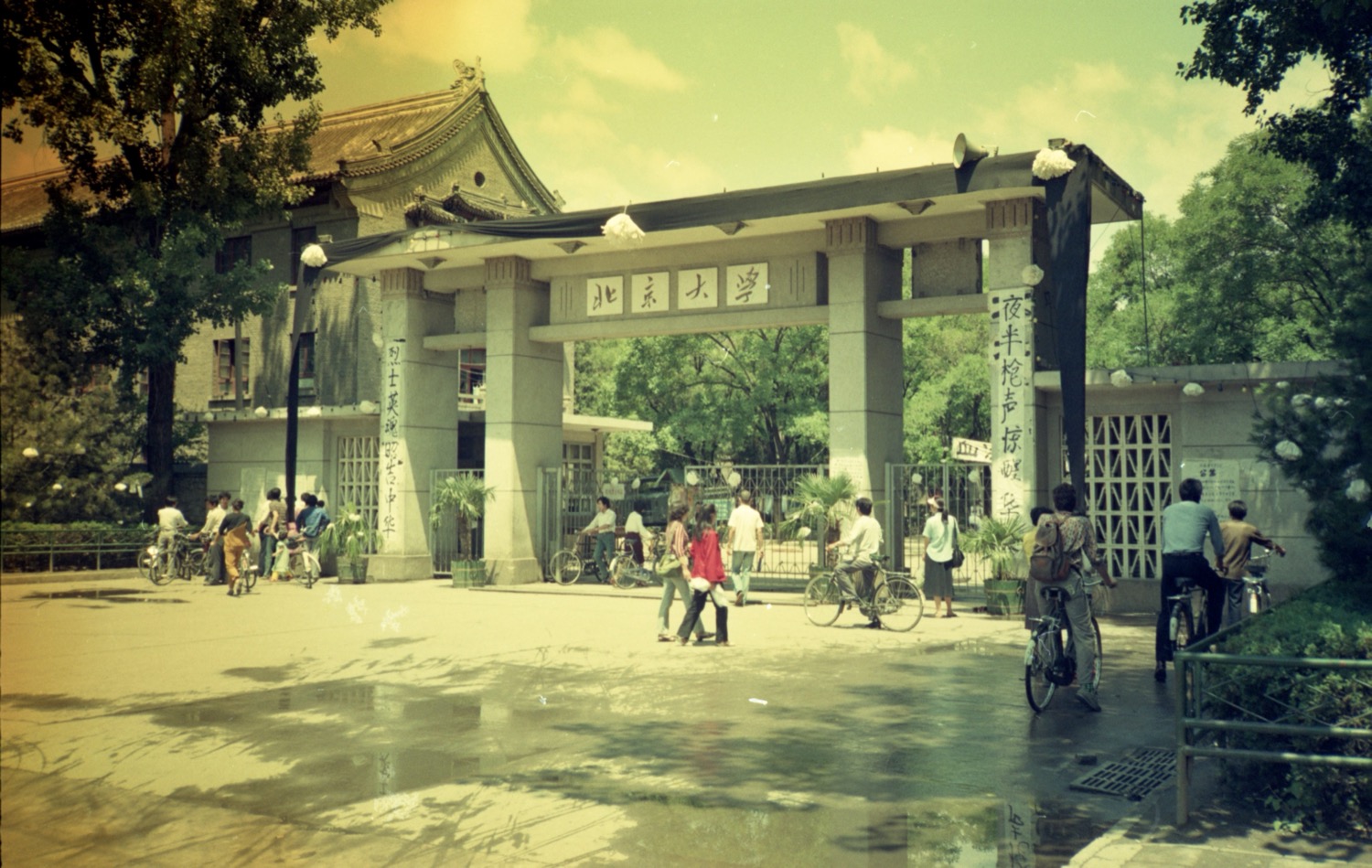
June 7–11, 1989. Mourning banners at the south gate of Peking University.
Daiwenchen · CC BY-SA 4.0. The site provides a resized copy and a grayscale crop in the timeline preview under the same license.

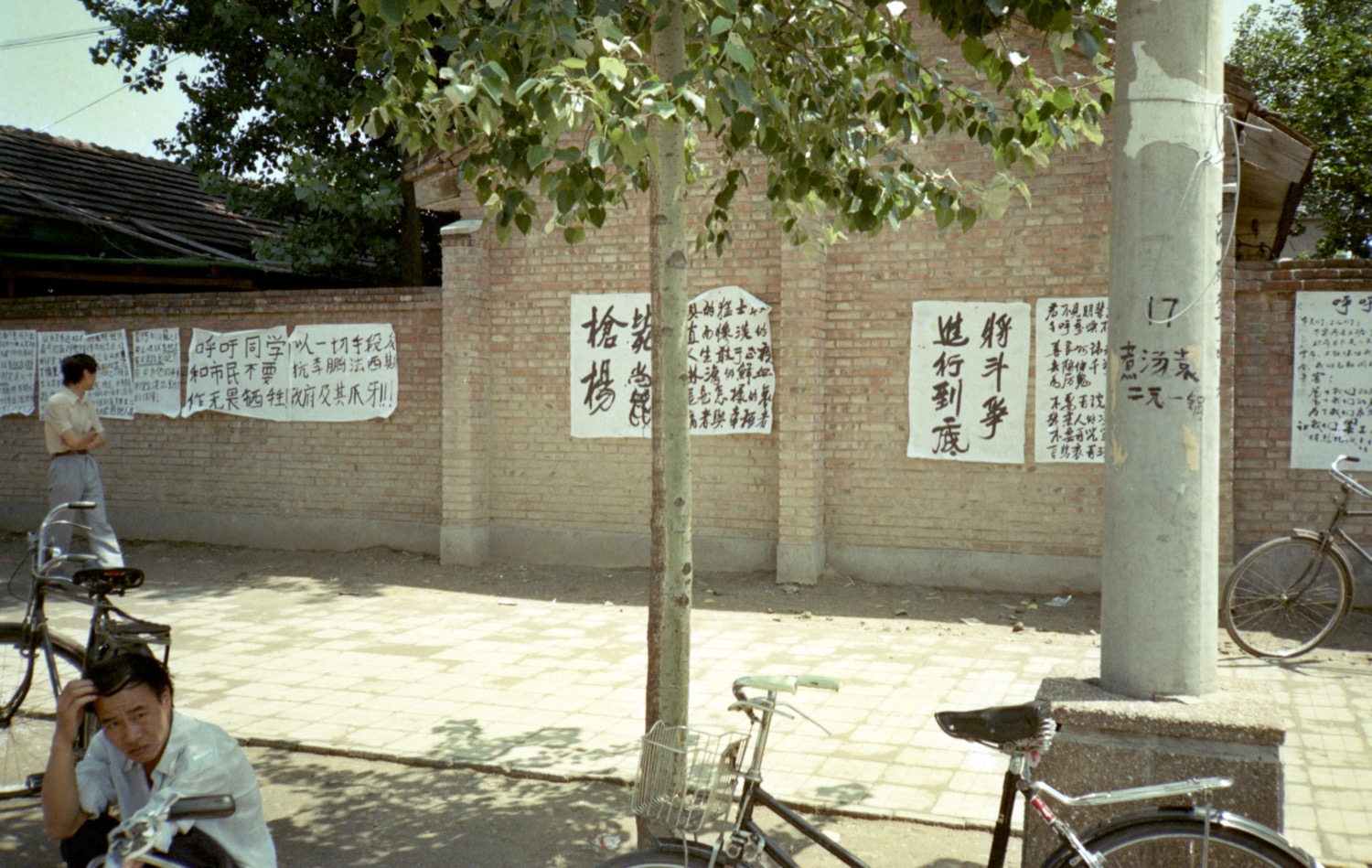
June 7–11, 1989. Notices posted along a street in Zhongguancun, Haidian.
Daiwenchen · CC BY-SA 4.0. The site provides a resized copy and a grayscale crop in the timeline preview under the same license.

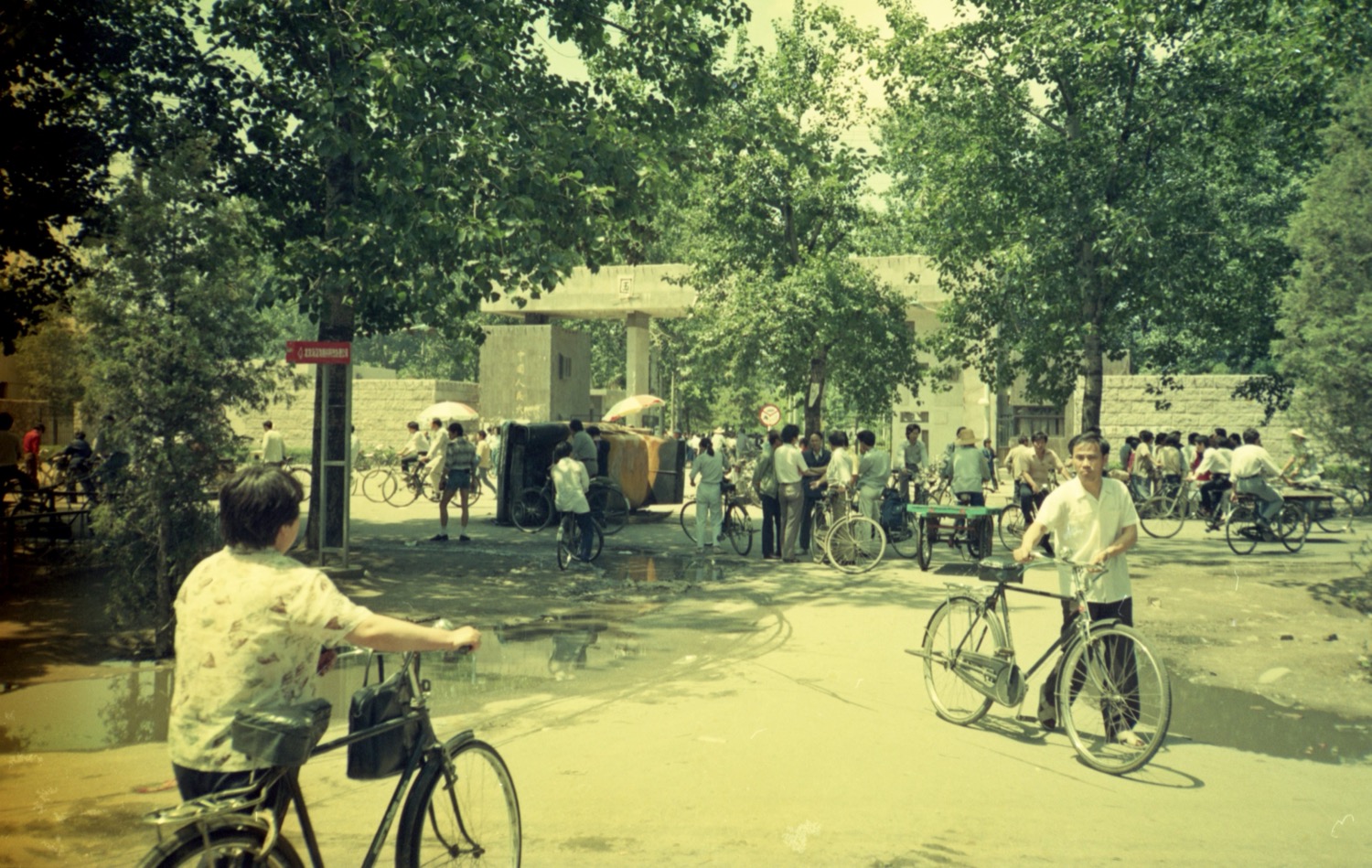
June 7–11, 1989. A burned car outside the east gate of Renmin University of China.
Daiwenchen · CC BY-SA 4.0. The site provides a resized copy and a grayscale crop in the timeline preview under the same license.

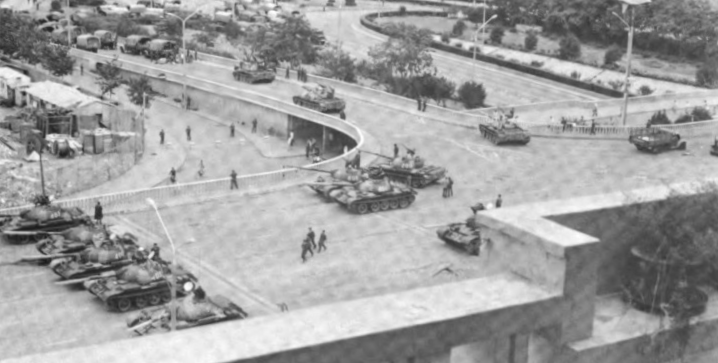
Tanks on a Beijing street in July 1989, photographed from the U.S. diplomatic compound.

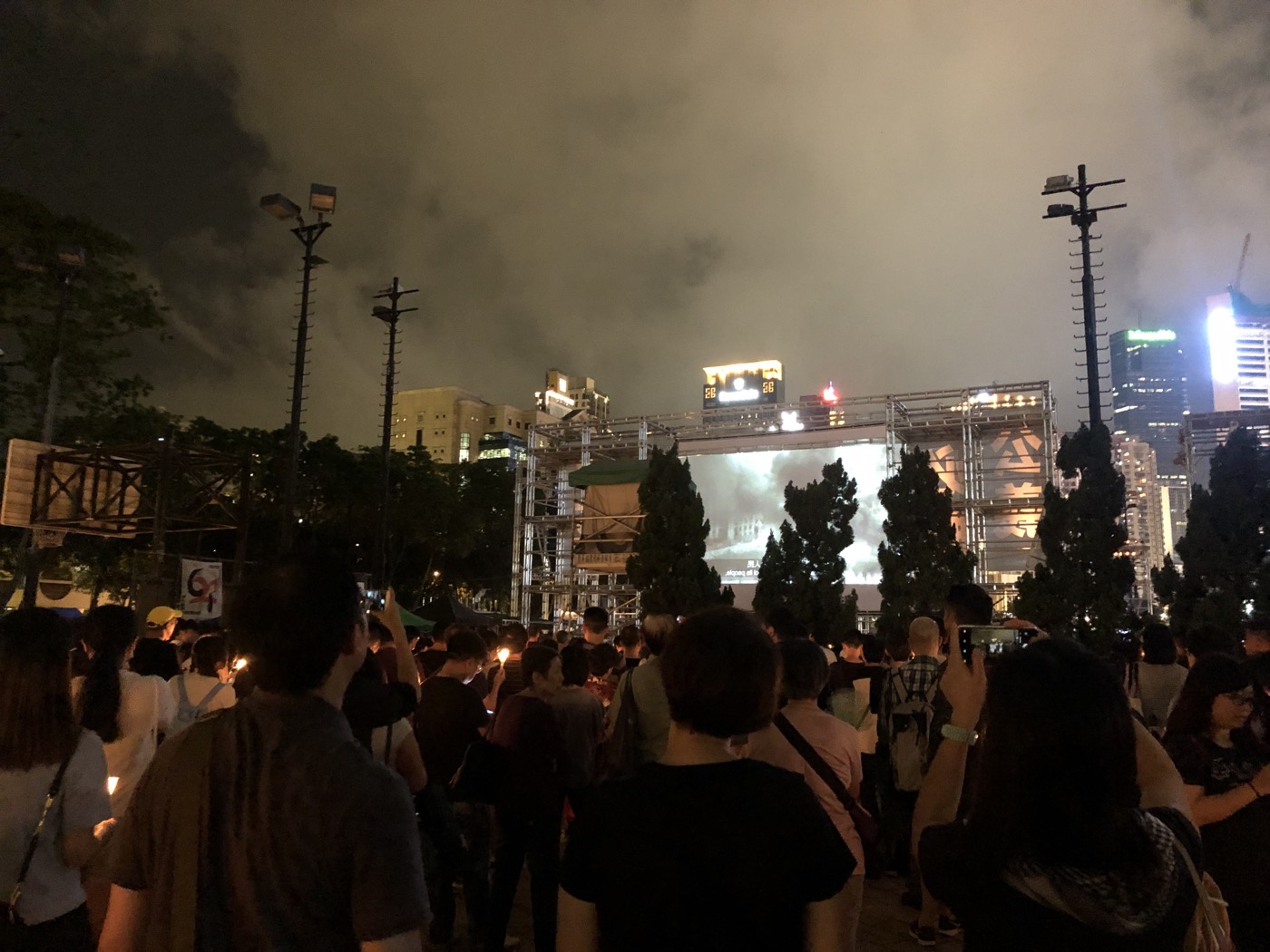
The thirtieth-anniversary June Fourth candlelight vigil in Hong Kong’s Victoria Park, June 4, 2019.

Primary sources and collections
- National Security Archive: declassified Tiananmen documents
Contemporary documents on martial law, the military advance and subsequent arrests. Two June 22 cables compile eyewitness material.
- Human Rights in China: survivor and family testimony
Testimony collected by the Tiananmen Mothers, indexed by name, including accounts by survivors, families and witnesses they interviewed.
- Indiana University collection: Tiananmen Square, 1989
The collection describes more than 400 black-and-white photographs by Edgar Huang. Individual records provide dates, places and usage terms.